
Sister chromatids cycle between nonresolved and partially resolved Biology Diagrams Sister chromatids, identical genetic copies of a chromosome, exhibit a fundamental behavior during cell division. These paired structures remain physically attached until a specific point in mitosis, known as anaphase. This separation is orchestrated by the spindle fibers, which are composed of microtubules that attach to structures called kinetochores on the centromeres of the chromosomes.

Advanced techniques allow researchers to observe sister chromatids' structure and behavior. Fluorescence microscopy uses dyes to visualize chromatids in live cells, while G-banding provides detailed chromosomal views. Confocal and super-resolution microscopy enhance visualization, and CRISPR-Cas9 tagging allows precise chromatid observation.
.jpg)
Dynamics of sister chromatids through the cell cycle: Together and ... Biology Diagrams
Understanding the behavior of sister chromatids in mitosis is essential for grasping how cells divide and reproduce. Prophase. In prophase, the chromosomes condense and become visible under a microscope. Each chromosome appears as two sister chromatids joined at the centromere. The nuclear membrane starts to break down, and the mitotic spindle
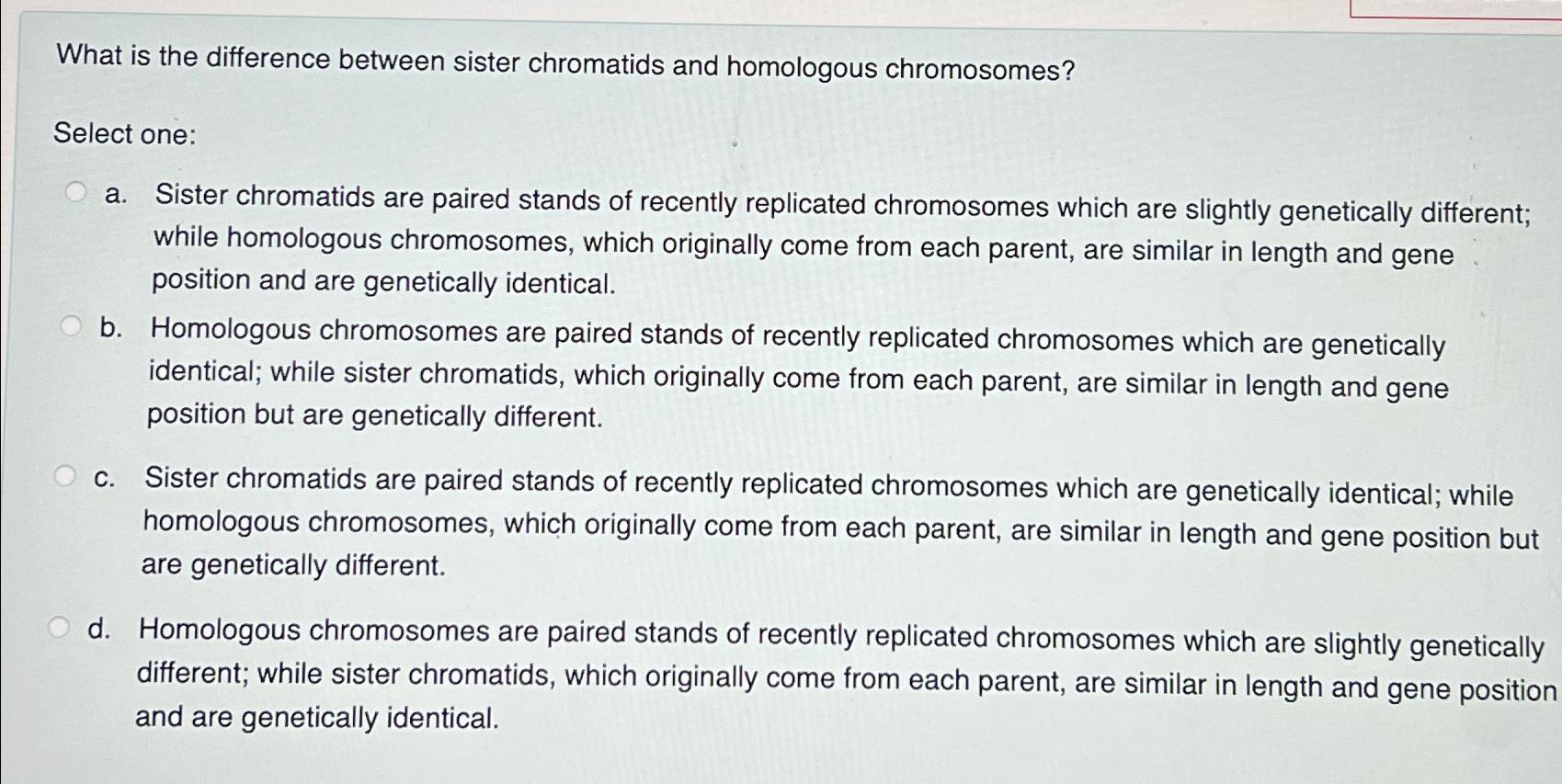
The identical copies of each chromosome are known as sister chromatids, and they are tightly associated together through G2 phase and early mitosis. During metaphase of mitosis, sister chromatids are associated with the mitotic spindle, aligned along the central axis of the cell, and one sister from each pair is associated with a separate
The Making and Breaking of Sister Chromatid Cohesion Biology Diagrams
If this process were essential for sister chromatid separation, one would expect to find cdc5 mutants that block anaphase initiation. Consistent with this possibility, in Drosophila, there are polo mutants that arrest in metaphase with unseparated sister chromatids (Donaldson et al., 2001). Whether this metaphase arrest can be attributed to a
